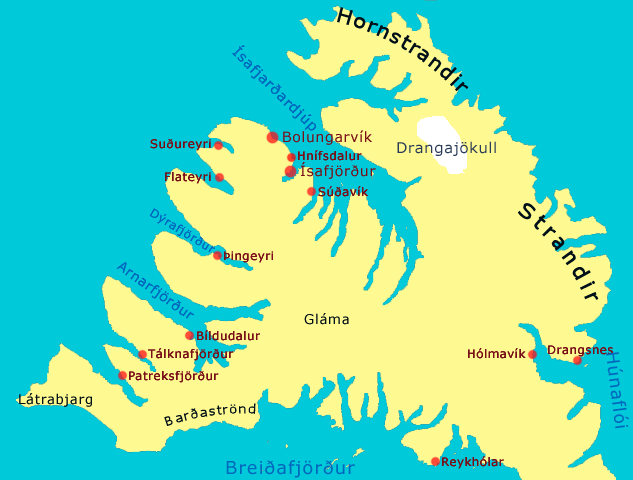
We went to Iceland in early September to see the Westfjords area as part of a photography workshop. The Iceland portion was technically just an “add on” to the original East Greenland trip, which will be coming up next. The Westfjords is the relatively remote area on a peninsula in northwestern Iceland. It is sparsely populated and loaded with steep seaside cliffs pouring into endless fjords. Our primary mission was to photograph coastal arctic foxes in the Hornstrandir Nature Preserve, but we had a few other stops planned as well.
The journey to get there was long, with three flights spread across a 24 hour period. The first leg was Denver to Washington, D.C. After a couple hour layover, we were on our way to Reykjavik, or more precisely, Keflavik international airport.We hopped on the “Flybus” shuttle from Keflavik to the Reykjavik city center, and then walked roughly a half mile to the Reykjavik domestic airport carrying a bunch of heavy photography gear and outdoor clothing.
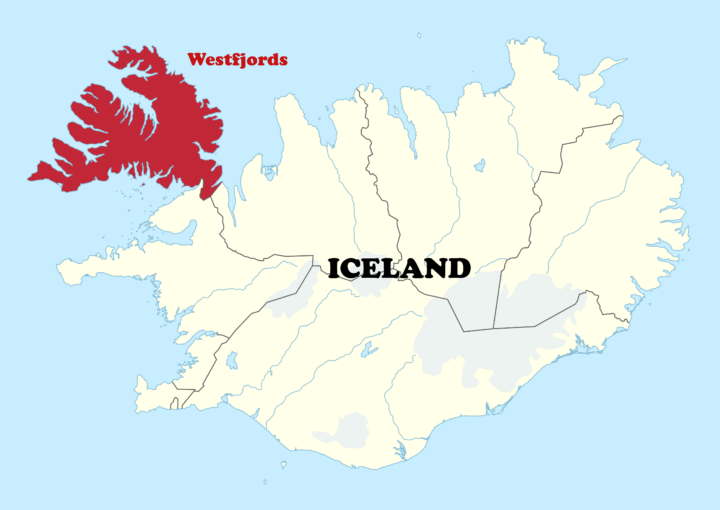
We met our group at the RKV terminal, and had a couple of hours to kill before the flight to Isafjodur (EESA-fyur-thur) in the Westfjords. Luckily this last leg was only about a 30 minute flight. We were fairly exhausted at this point, but excited to be in Iceland at last. Our guides arranged for a group dinner on arrival, and then we crashed for the night at Hotel Horn.
It was a short-lived break. We were off the next morning for a 2.5 hour boat journey to Hornvik on the far northern coast of the Hornstrandir Nature Preserve. The area boasts some dramatic scenery and is known as an arctic fox habitat. We would also be spending the night at “The Old Doctor’s House” in Hesteryi, which is also in the nature preserve, so packed up our photography gear and an overnight bag and left the bulk of our luggage back at the hotel.
As we were leaving the room, I noticed the bed where I had packed my camera bag was wet. Soaking wet. I immediately knew that my 2 liter water bladder had burst in my pack. I tore it open and at least found that the camera gear was safe and sound. Unfortunately, the entire back surface was soaked, meaning that it would instantly soak my clothes when I put it on, which would obviously not be a good condition to start a two day outdoor trip into the arctic.
I used the hotel blow dryer to get the worst of the water out of the pack. After half an hour, it was tolerably damp, and it was time to go. We gobbled the continental breakfast at the hotel, and then grabbed some cold cuts for a picnic lunch from the local market. Then it was off to the boat. We were fortunate to have a 30-passenger boat dedicated to our 12 person group, leaving plenty of room for all of us with our bulky camera bags. After a brief safety briefing, we set off to sea.
Tuesday, September 1: Hornstrandir
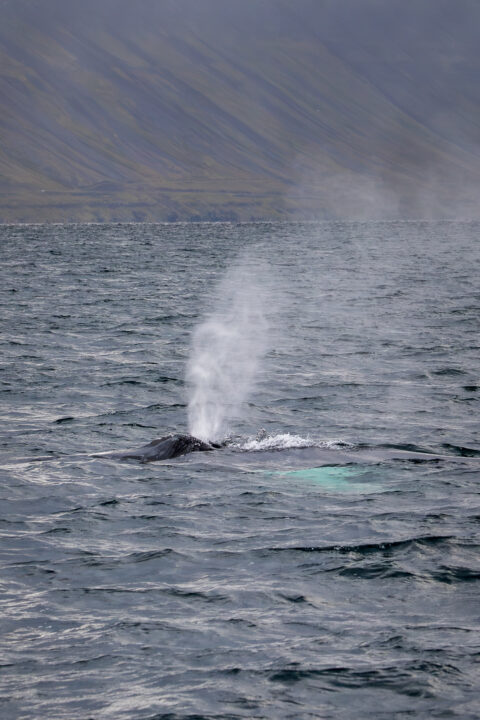
Within five minutes of leaving the dock, we spotted a humpback whale in the fjord. It bobbed around us for a few minutes before making the classic whale dive, posing with it’s tail in the air as if it knew a boat full of photographers was watching. We were all ecstatic to have had a close encounter with such a magnificent creature, but we weren’t done yet. Within minutes, a pod of four or five whales surfaced right next to our boat. They seemed to be playing with each other, and we were happy to watch. At times, they were just a few yards off the boat. One by one, they then proceeded to dive, each of them presenting their tails just as proudly as the first had done.
We have seen whales in Alaska, Antarctica, and now Iceland, and it never disappoints. It is simply magical, especially when you’re observing them from a boat that is smaller than they are. We were all grinning ear to ear, and sharing our snapshots with each other as we turned out into the open sea.
At this point, the situation took a dramatic turn. The swells were immediately obvious, and coming from multiple directions at once – what mariners call “confused seas”. The further we went, the rougher it got. I was standing on the aft deck, partially to continue taking in the scenery and partially to keep the fresh air in my face to help ward off the seasickness. The spray started soaking the deck, driving us all back inside. Then people started turning green.
Spray or no spray, I decided the cold, fresh air beat the stuffy interior of the cabin. I went back out on deck to ride it out. A few people came to join me. One of them immediately headed for the side of the boat to relieve himself. By this point, we were pitching and rolling quite a bit. A few passengers reached for life vests.
Suddenly it seemed like the boat was floating in the air, and for an instant, all was quiet. Then the bottom dropped out. Everything on the boat was thrown into the air. Those of us on the deck were tossed around like dolls. Alarms were sounding in the cabin. I felt my knee buckle underneath me and then crash hard into the deck. Luckily, I was wearing knee pads meant to protect me while kneeling on rocks and ice. It turns out they work pretty well on boats too. I limped back into the cabin with what I’m pretty sure is a sprained ligament, but at least I was walking.
The crew was extremely attentive, and made sure that everyone was OK as we got back underway. Then the captain joked, “You know what we call this in Iceland? Tuesday!” I have to hand it to that captain. He knew what he was doing and navigated those waves expertly. It was just us greenhorns on board that were having all the trouble. And that’s when the retching started. Several of our group started making use of the seasickness bags, which was enough to drive me back outside, gimp leg and all.
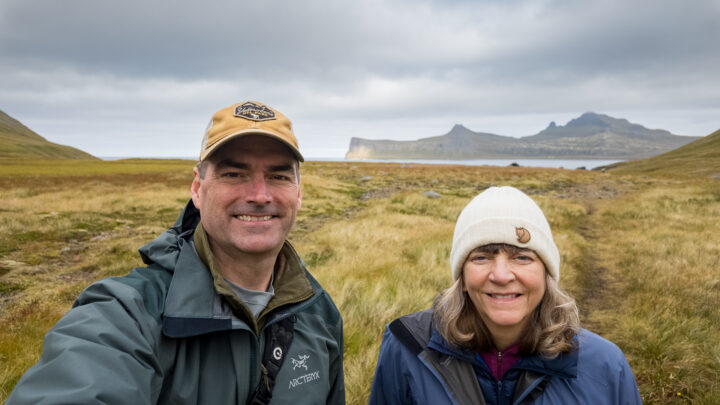
After an hour or so, we rounded the turn into the Hornvik fjord and things settled down significantly. We transferred to shore on a zodiac. Since most of us had done this in Antarctica, it was old hat. There is a wilderness campground at the site, and there are still a few houses left standing from the settlement that was abandoned in the 1950’s. The houses are still passed down through the families and used as weekend cabins. It’s amazing to think that people lived in such a remote location.
We had a picnic lunch on the campground and then hiked around a couple of the coves for a while. Our group saw a handful of foxes. Lara and I were in a group that only saw a couple, but it was still quite an experience. Coastal arctic foxes are generally a bluish-brown, and known as “blue morphs”. These are more rare than the white morphs, but they generally live in eastern Iceland and the highlands. They are smaller than the American red fox, which, combined with the camouflage, makes them quite difficult to spot.
Our guide recommended that we check out the adjacent valley. It was about a 45 minute walk each way. Since our time in Hornvik was limited, we decided that a few of us would take the zodiac back around the point to check it out. Along the way, we saw a few seals poking their heads out of the water, obviously curious . The other valley was beautiful, but after half and hour exploring, we found no foxes and decided to head back to the original site.
When we arrived, we found that the other part of our group had spotted a handful of foxes along the beach. Almost on cue, one came walking along the dunes towards us and the campground. We watched it for a while as it sniffed around the tents, clearly understanding that human campers bring food, but he didn’t do much more than sniff. With that, our time at the site was done, and it was time to zodiac back to the boat.
Wednesday, September 2: Hesteryi and Isafjodur
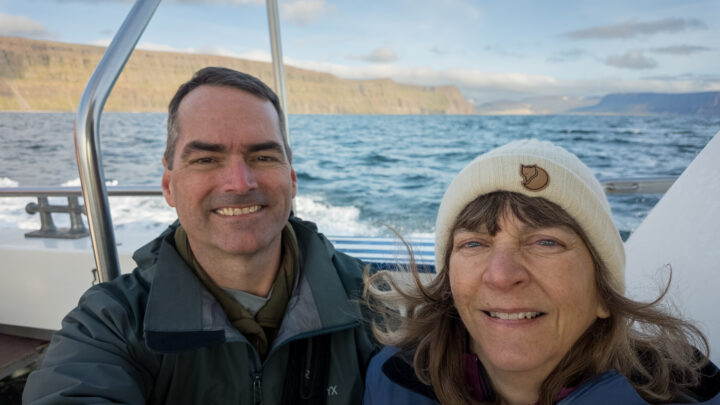
The ride back to Hesteryi, on the south side of Hornstrandir, was a night-and-day difference compared to the outbound ride. The seas had calmed significantly, allowing us to enjoy the coastal scenery and fresh air without having seasickness bags constantly at the ready. We enjoyed watching the low late summer sun paint the cliffs.
Our destination was the Old Doctor’s House in Hesteryi, a similarly abandoned village that has a handful of standing structures. The Old Doctor’s House is exactly that, and is now operated as a day cafe and hostel by descendants of the doctor, who left town with the rest of the population in the 1950’s. We arrived at low tide, which required another zodiac transfer to the dock. Then we set out around the area photographing the sunset. It was a stunning evening, with light glancing off the terrain and numerous surrounding waterfalls. A photographer’s dream.
We spent an hour or so photographing the area immediately around the house before we were called in for dinner. The hosts prepared a fabulous Icelandic meal and told us the story of the town and their family. The patriarch even pulled out an accordion to entertain us with a few songs. One of our guides, Nick, used to be a drummer in a band, and the host handed him some sort of “percussion box” for an impromptu jam session. It was one of those moments that you have to experience to understand.
At bed time, we headed upstairs to the three communal bedrooms equipped with 3-5 bunk beds each. It worked out such that the women could take one room and the men could fill the other two. Needless to say, we got to know each other quite well very quickly. This would be the start of several comments about snoring, but on the whole we all slept soundly after a long and memorable day.
I woke before dawn to check out the sunrise. It was quite overcast, so we didn’t get any new amazing photos, but it was still quite beautiful. I found 3 seals laying on the rocks just off shore and knelt to get what I thought would be a really cool image, when I realized that I had taken the battery out of the camera to charge and failed to take it off the charger as I was quietly sneaking out of the house with some of our group still sleeping. So, I sat and watched them watch me for several minutes, just soaking in the scene.
The hosts once again prepared an excellent breakfast and played some Icelandic folk songs on a traditional instrument, the langspil, while we ate. We were all fully into the Iceland vibe at this point. I have to say, the entire experience at the house was simply magical.
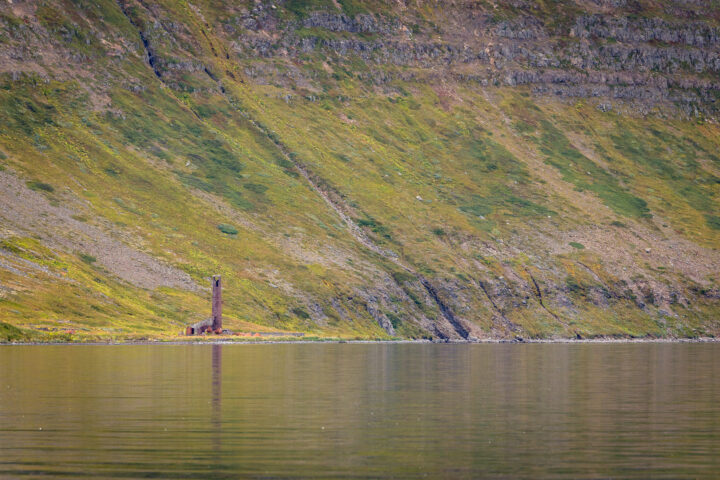
We hiked to an abandoned whaling station nearby for the morning photography expedition. Dilapidated buildings can make for inspiring imagery, especially in settings like this. We were enjoying taking some photos from various angles, when another of our guides came running over to let us know there was another fox on the back side of the building. We all gathered around from a respectful distance, watching as it stretched and climbed further up the dirt bank that had accumulated along the wall. It gave us just a brief show before curling up and going to sleep. A few of us watched it for nearly an hour, hoping that it would wake up and allow us to capture some truly memorable photos, but it was pretty content to lay low until it was time for us to leave.
We boarded the boat back to Isafjodur, basking in the memories of the last 24 hours. As we entered the Skutulsfjörður, the fjord surrounding the town, we spotted a few more whales and followed them until it was time to head back. We had a couple of hours to shower and get a change of clothes, then we boarded a van and headed to a scenic lookout in Bolungarvik for some sunset photography.
At the overlook, several of us took a stab at using our drones. I’m a novice drone pilot as it is, but I had never attempted to fly around other drone users, which made me pretty uncomfortable. After a few minutes, I put it away and resorted to my traditional camera. The sunset wasn’t dazzling, but it was a pretty view over the surrounding fjords.
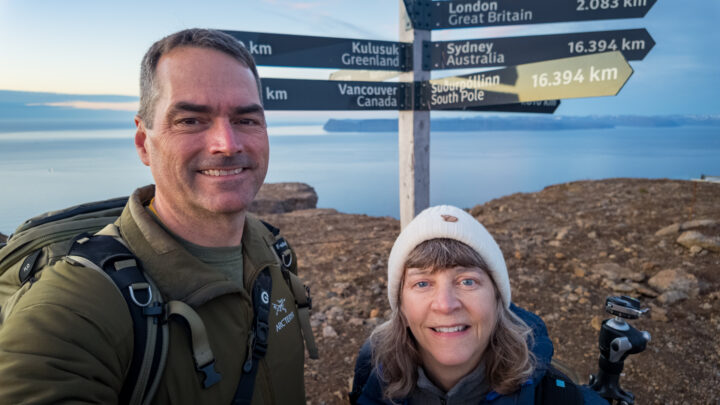
Thursday, September 3: Dynjandi and Flateryi
Thursday morning we once again piled into the van. The morning stop was the Dynjandi waterfall. The route took us through one of the many tunnels in the area. This one was 6km long and had a split in the middle that led to two different towns.
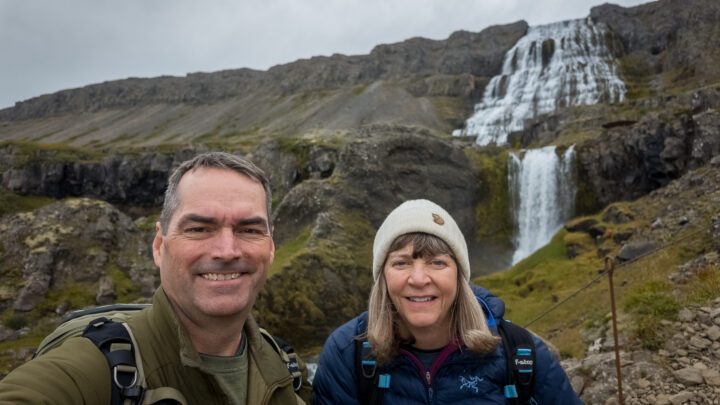
I had seen some photos of Dynjandi on line, but I have to say none of them did this place justice. Most of the pictures are of the top cascade, also known as Fjallfoss, which is the tallest at roughly 100 meters high. There are actually 7 separate cascades in sequence, ranging from a handful of meters to about 20 meters. It’s a really impressive site. The only way you can get any sense of the scale is to look for people in the pictures. Often, there is someone there, but they are so small you have to really inspect the image to see.
We spent a couple of hours hiking around the waterfalls, taking different images along the way, and some of our group even hiking through the water to model for the other photographers. We headed back down for a picnic lunch at the base before heading back to the van for the next destination.
We drove to the town of Flateryi to stop for a coffee break. Lara and I explored the town on foot. It turns out this village was “flattened” (no, that’s not the reason for the name) by an avalanche in 1995 that killed 20 people. There’s a little monument in a park that tells the story, though it’s all in Icelandic, since this isn’t a tourist destination.
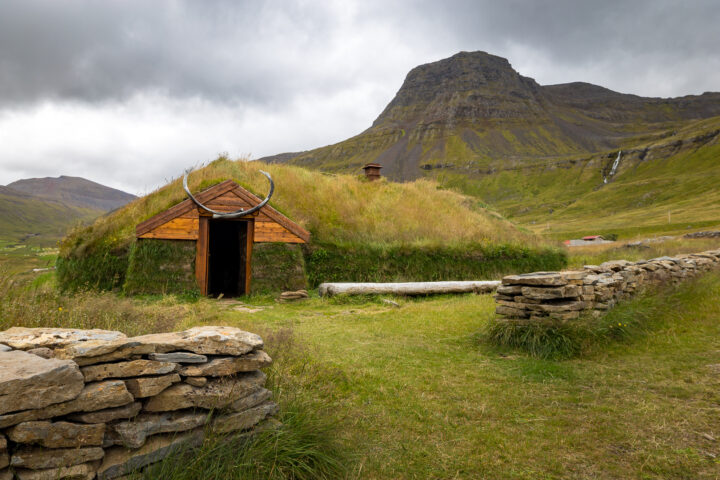
Our final stop of the day was at a replica of a Viking longhouse in a nod to the early European settlers that discovered the island. These houses were primarily built from sod, because there is very little wood available on Iceland. It wasn’t our most photogenic stop, or maybe we just don’t have an eye for “architectural” photography, but it was interesting to explore.
We headed back to Isafjodur for a group dinner at “Tjoruhusid”, a local seafood buffet, but it is not at all what you would expect from an American buffet. All of the fish is fresh – hauled in by local fisherman that morning. It’s a family run place, and one of the sons does this dramatic introduction on the history of the place, the menu for the day, and the process for serving. It’s a little strange hearing an Icelandic man use words like “Dickensian” to describe the food line right along side slang like “grody”, and then praising the virtues of “wonderful gluten” before warning everyone that most of the dishes included it – very entertaining. The food was fantastic. Lara is generally not a seafood eater, but even she liked the fish soup and the three or four different types of fish. They served halibut, cod, char, and a few others I can’t remember.
In the morning it was time to fly back to Reykjavik and meet the rest of our group before starting the Greenland portion of this adventure. The tiny airport in Isafjodur has precisely two flights a day, one in the morning, and one in the evening. There is no security. No shuttles. No lines. Just walk up to the counter, grab your boarding pass, and head to the gate. Ah, the good old days of air travel…
Friday, September 4: Reykjavik and Gardur
After touching down in Reykjavik, we boarded a bus to take us to Gardur, which is a little south of the Keflavik airport. There are a couple of lighthouses on a point at the far southeastern tip of Iceland. We met the rest of our group at the Lighthouse Hotel and had our welcome briefing for the Greenland trip, which promises to be another incredible experience. We had another group dinner to get to know the rest of our crew, now 16 total, and then off to bed to get as rested as possible for the next few days.
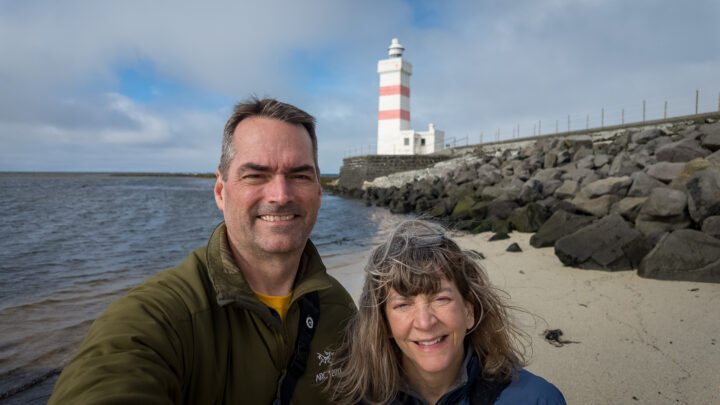
As is the case with many of these trips, we have sworn to come back to Iceland. Lara will assert that we should stick with land travel next time. I’m not entirely convinced of that, but one way or another, this country has much to experience. We can’t wait to return, but first, we have another adventure in store. It was time to go to Greenland.


Martens
24 Sep 2026Absolutely incredible! Both your words and your photos are truly impressive. Seems to me, your workshop adventures keep getting more grand and certainly come with some interesting challenges. After reading about the rough sea, I am really glad you and Lara are home safe and sound!
Love, Mom